
Modern autonomy stacks can produce robot software, models, and behaviors. What they still lack is the operational layer that decides what runs, where it runs, how updates move safely across the fleet, and how operators recover when execution diverges from plan.
Autonomy fleet operations
Deploy, run, and control autonomy workloads across distributed fleets.
AutonomyOps is the operational runtime and rollout platform for autonomous systems. It controls what runs across your fleet, how software propagates, and how systems recover when connectivity is intermittent, propagation depends on relay paths, and field conditions break ideal infrastructure assumptions.
- Runtime control for fleet workloads
- Safe, policy-driven rollout
- Recovery under degraded conditions
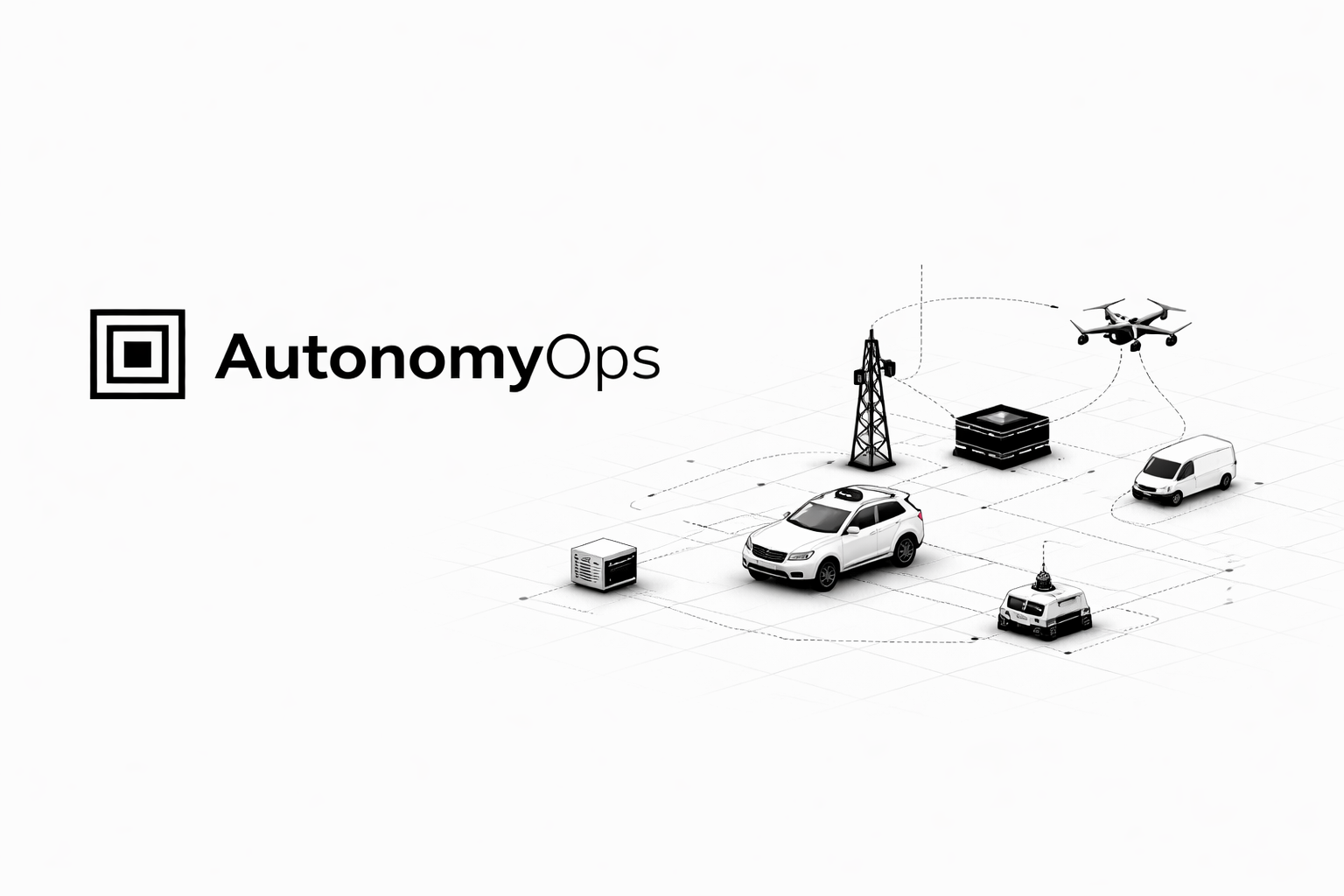
What AutonomyOps is
The operational runtime and rollout platform for autonomous fleets.
AutonomyOps sits between software release intent and fleet execution. It helps autonomy teams deploy, run, update, and recover workloads across fleets operating in degraded, disconnected, and edge-constrained environments.
Category
AutonomyOps is the runtime, rollout, and recovery layer for autonomous fleets operating beyond ideal infrastructure assumptions.
System model
Control-plane + edge runtime + operator control.
AutonomyOps connects release intent to real execution. The control-plane coordinates rollout, the edge runtime enforces and executes state locally, and operators retain safe recovery workflows when the fleet does something unexpected.
Control-plane
Defines rollout intent, promotion logic, policy, and coordination behavior across the fleet.
Edge runtime
Executes and reconciles workloads on each node, preserving local control and safe behavior even when connectivity degrades.
Operator control
Provides inspection, halt, rollback, and recovery paths when rollout or runtime behavior diverges from expectations.
Core capabilities
Built to control execution, propagation, and recovery across real fleets.
Fleet workload control
Ensure the correct autonomy workloads are running across every node in the fleet, with explicit control over desired and actual runtime state.
Safe rollout execution
Coordinate phased deployment with bounded blast radius, explicit promotion logic, and controlled progression across heterogeneous fleets.
Runtime reconciliation
Detect and correct divergence between intended and actual execution state across distributed edge systems.
Relay-aware propagation
Support software movement across constrained, multi-hop, or intermittent networks where direct central reachability cannot be assumed.
Operator recovery workflows
Give operators a controlled way to inspect, halt, roll back, and recover when rollout, runtime, or connectivity breaks down.
Fleet-state visibility
Preserve the operational context needed to understand what changed, where it propagated, and how the fleet transitioned through runtime and rollout state.
When teams need AutonomyOps
When software delivery becomes a control problem.
AutonomyOps becomes necessary when autonomous systems are too operationally sensitive for casual deployment behavior. At that point, software rollout is no longer just a pipeline problem. It becomes a runtime control, propagation, and recovery problem.
- Updates propagate inconsistently across reachable and unreachable assets
- Connectivity depends on gateways, relay nodes, or delayed synchronization
- Operators need safe halt, rollback, and recovery paths instead of guesswork
- Fleet-state visibility matters as much as software version delivery

Why it matters
Traditional DevOps was built for reachable services. Autonomous fleets are a different operating problem.
Conventional software ops
- Assumes stable reachability
- Optimizes for service uptime
- Treats deployment as a pipeline event
- Focuses on application health in fixed environments
AutonomyOps model
- Designed for degraded and disconnected conditions
- Optimizes for safe state transitions across fleets
- Treats rollout as an operational control problem
- Accounts for runtime state, relay paths, and operator recovery
What the workflow looks like
From release intent to controlled fleet execution.
Without AutonomyOps
Push updates blindly, hope they propagate, lose visibility into execution state, and improvise recovery when some nodes lag, fail, or go unreachable.
With AutonomyOps
Define desired state, control propagation, observe fleet progression, reconcile drift, and intervene safely when conditions degrade or execution diverges.
Execution loop
Declare desired state → propagate safely → observe fleet → reconcile drift → halt or recover when needed.
Release control
Gate rollout progression with operational policy instead of relying on manual, one-off judgment under pressure.
Propagation control
Support multi-hop and intermittent delivery paths where timing, topology, and delayed synchronization materially affect deployment behavior.
Recovery discipline
Replace ad hoc rollback decisions with explicit, operator-safe workflows for failure handling, degraded coordination, and controlled recovery.
Who it is for
Built for autonomy platform and robotics infrastructure teams operating distributed fleets.
Designed for teams working in degraded, disconnected, or edge-constrained environments where workload execution, rollout timing, propagation behavior, and operator recovery cannot be treated as afterthoughts.
AutonomyOps
The platform that controls what runs across your fleet.
AutonomyOps gives autonomy teams a way to deploy, run, update, and recover distributed systems with discipline, visibility, and control.